
One might think that befriending the international students from Sweden during my studies was all part of a bigger plan to get invited to their homeland.
I wish I were that clever.
Yet that’s exactly what happened!
It was an accident, I swear…
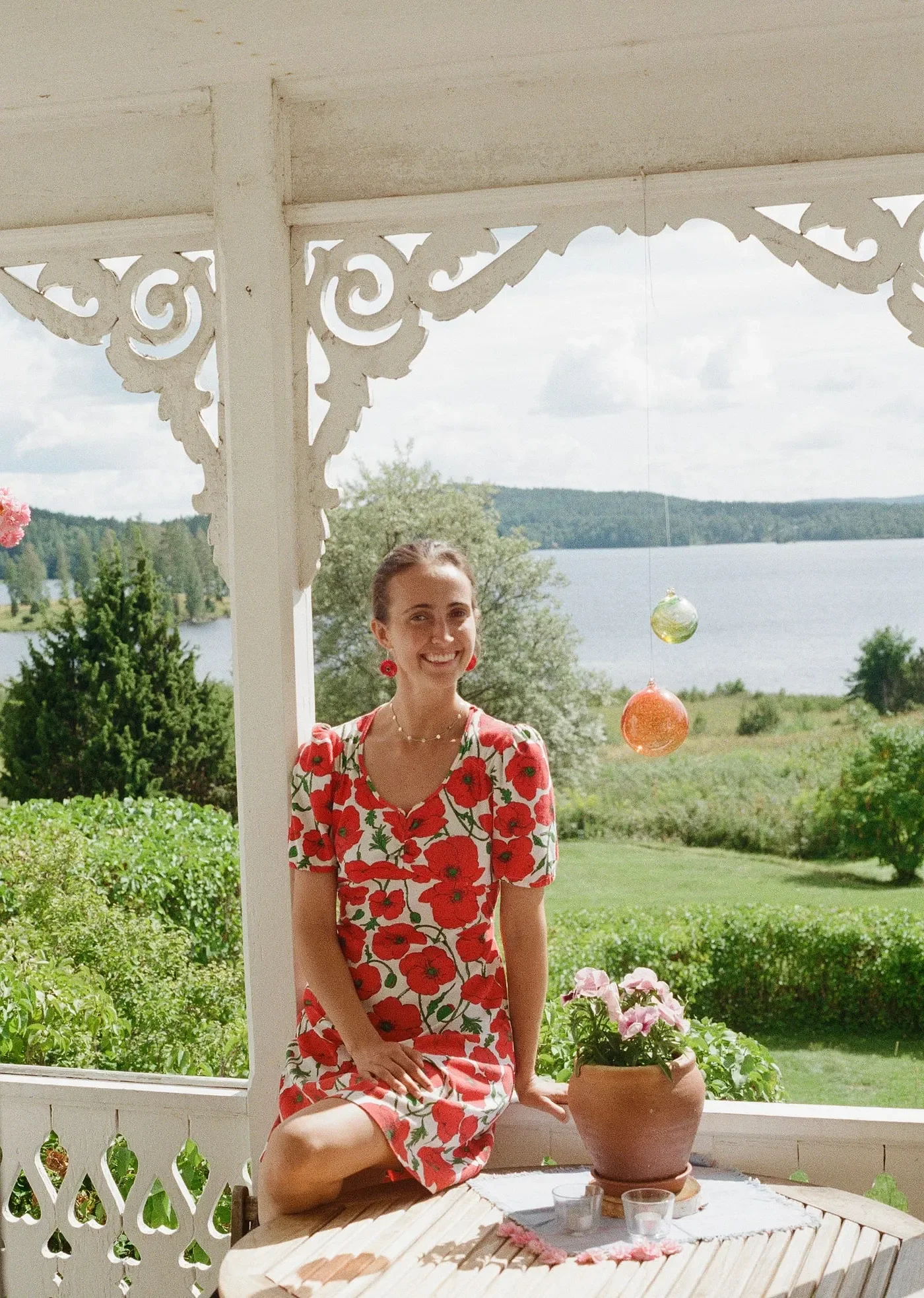
It was an accident, I swear!
Once upon a snowy December ago, I left Sweden for the first time with all the essentials: a hand-carved Dala horse, Strömshaga kerosene oil lamp, Christmas window star (adventsstjärna), a bag of raisin-stuffed lussekatt, salty black licorice (salmiak), Santa Lucia serenades, pepparkakor from Liseberg, mulled wine (glögg) from Gamla Stan Christmas market, and…a case of coronavirus (woohoo — 6 more days in Gothenburg)!
I have one person to thank for all of this: Imke.
If you know me, then you know Immie: my dear German soulmate-sister whose path crossed mine during her exchange year in Chapel Hill. Having lived six collective years across Sweden, I’ve gotten a saffron-infused taste of the country through her integration experience.
Side note: There is a stereotype that Germans, generally speaking, are obsessed with Sweden. Say what you will about that. And while Imke claims that she didn’t grow up in one of “those” families, she has nonetheless fallen victim.
While frozen archipelagos are its own kind of beautiful, Sweden in the summer is a different story. “The social life of a Swede in the summer is hectic,” according to my fated friend Nils Elofsson. And it’s true: a winter’s worth of hibernation manifests in three crammed months of extroversion while the midnight sun is out to play and the entire country abandons their workplace for five weeks.
Having embraced this phenomenon as part of my own anthropological experiment, I can now confirm Nils’ statement. I spent the peak summer month of July generously welcomed into the childhood cottages of international students turned forever friends; transforming the people I thought I knew from 2D-paintings into 3D-printed versions.
My notebook is filled to the brim with reflections and observations, one-letter words and idioms, blissful anecdotes, wild blueberry pie recipes, and sketches of bustling harbors & garden cafes.
My brain is overwhelmed with new words and customs that are untranslatable into English (take care to find these words and you are entering the portal into another culture’s priorities).
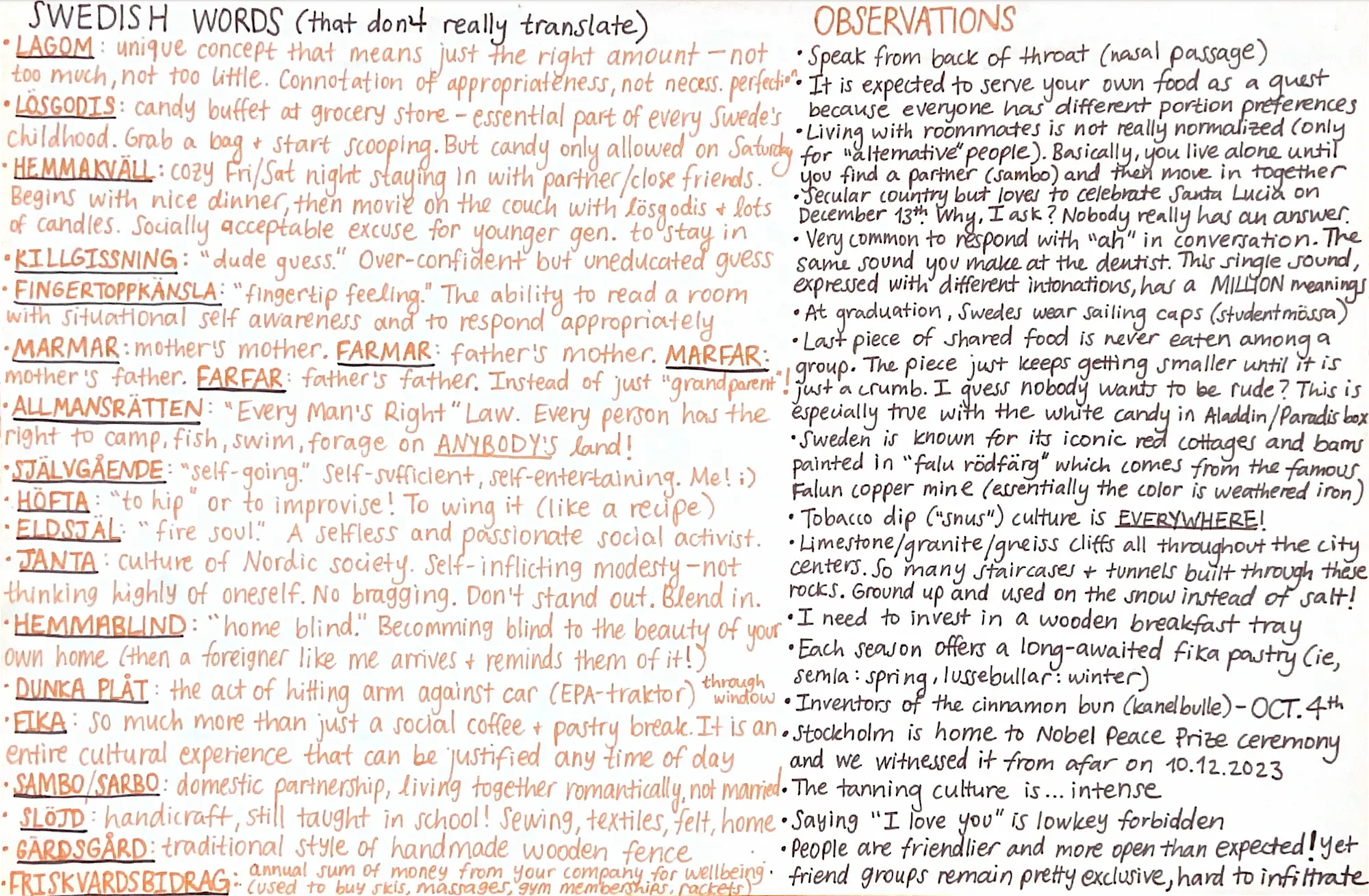
Snapshot of the madness
Every detail inside a Swedish home is intentional and curated with the foresight of coziness: striped ceramic candlesticks, freshly plucked poppies on lace tablecloths, black-and-white photos of great-great-great-great grandparents making candles in the same exact spot, treasure chests full of hand-written family letters dating back decades, painted landscapes of the backyard framed on the wall, red dala horses perched on the white-tiled bathroom windowsill.
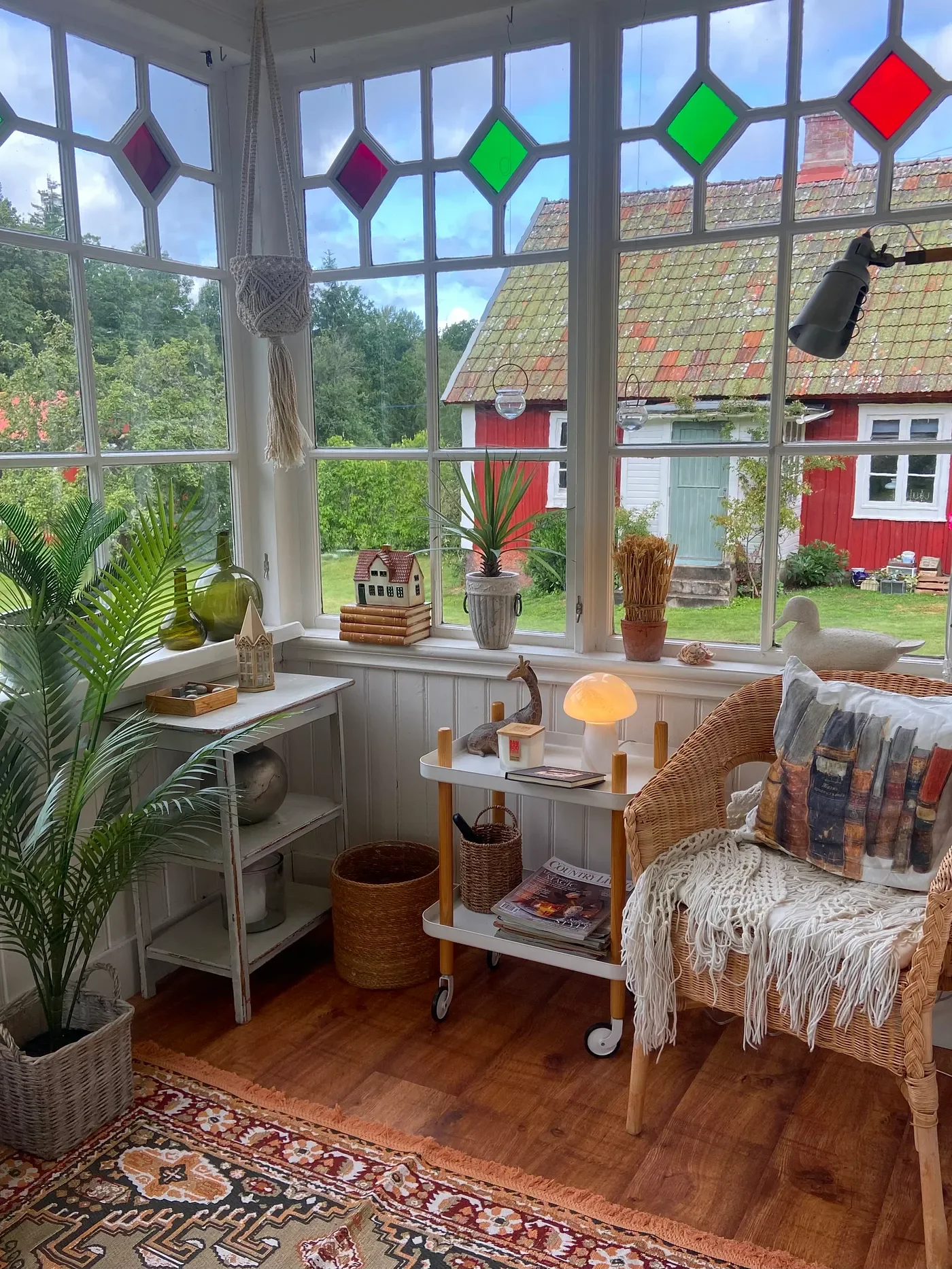
Exhibit A: The Mårtensson’s reading room (photobombed by our cozy red cabin for the night).
Being invited into a Swedish home is a sign of trust. After all, it can be quite vulnerable to bring a stranger into a home that, more often than not, has been passed down through generations.
To say that Swedes have a deep reverence for the land on which they grew up would be an understatement. It’s as if traces of their DNA can be found in the soil beneath them; ancestral footprints excavated at every turn.
Many Swedes (particularly those from the countryside) have a matter-of-fact understanding that no matter how far they go, they will ultimately return home. Something invisible tugs them back after living out their dreams in Stockholm, Brussels, NYC. To die on the same land that raised them is not completely uncommon.
I can’t help but compare this to the incredibly different American context, where it is quite normalized to move around throughout childhood (and sometimes even permanently settle halfway across the world).
For example, if you ask an American a simple question like, “where are you from?”
You could hear something like this:
“Hmm…well I was born in Ohio, but we moved to Florida for my parent’s job, then I spent the last four years studying in Arizona and now I’m working abroad.”
Or perhaps they just moved around 3–4 times, within one city (like myself).
Now if you ask a Swede where they’re from, you will likely be met instantly with one precise address:
“Lingonstigen 6.”
Witnessing this deep sense of home forced me to confront a new feeling of grief: I don’t feel this life-death connection to my birthplace, yet I crave that. Where do I belong? Is there a place that is sacred to me? One that carries an ancestral footprint to which I can always return?
These questions led me to spend the following months cultivating an unexpectedly magical connection with my grandfather’s seaside cottage (dacha) in the Latvian countryside. After all, it will be mine someday…but that’s another blog post!
July 2023
My voyage to Sweden actually began with a 24-hour overnight ferry across the Baltic Sea to Germany.
I shared the questionable, low-budget, Danish ship with Finland’s vintage car club and German bike-packers who further opened my mind to slow, intentional, sustainable travel. What’s the point of biking across four countries in sixty days just to fly back home within an hour’s time?
Witnessing the sun set and rise on the endless seascape horizon was a spiritual experience that made every minute of sleeping in the movie theatre seats worth it.
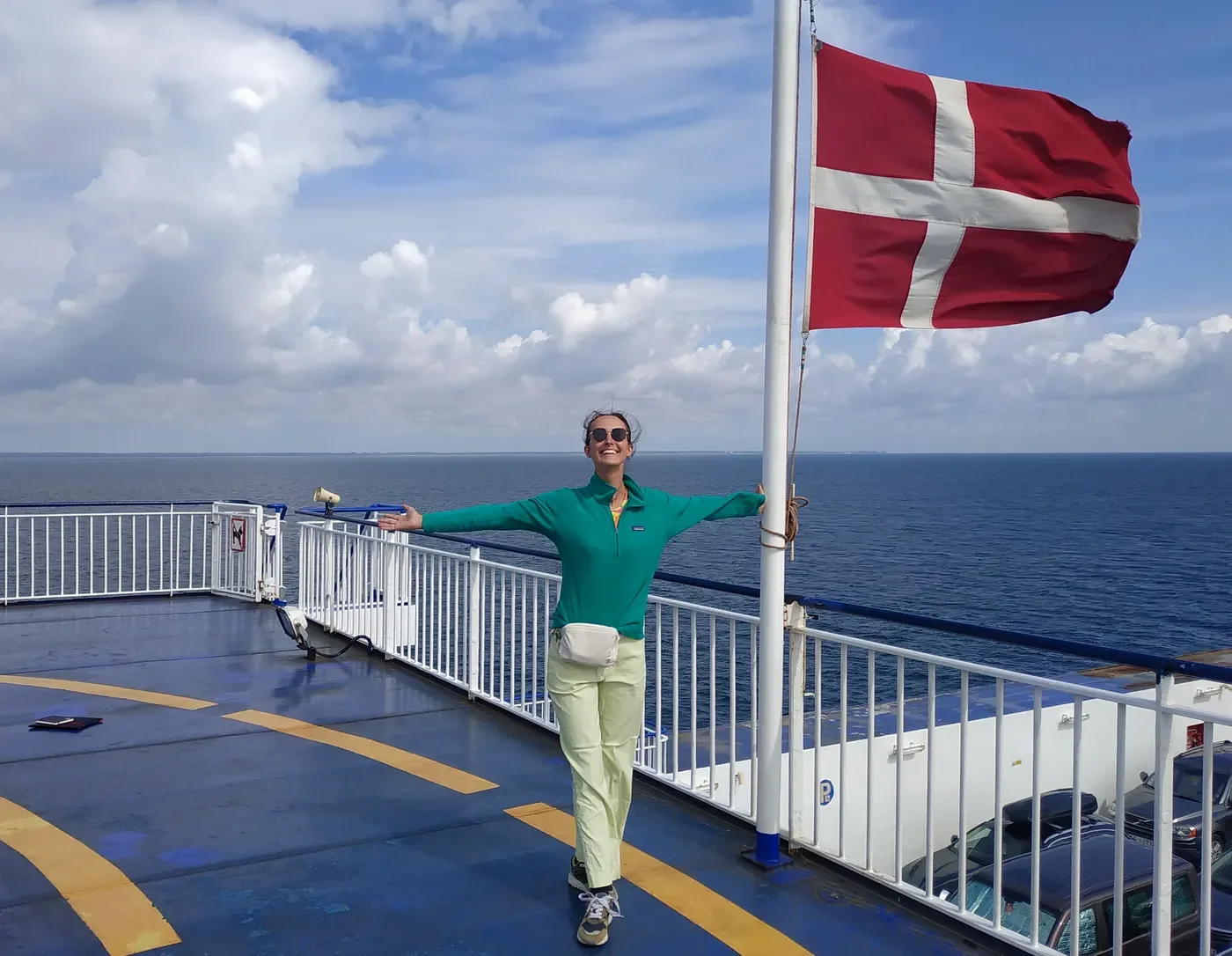
Did I miss my original ferry in Liepāja, frantically buy another ticket for the next afternoon, and disappoint my adopted German family by being 27-hours late? Yes.
After being smothered in endless Brötchen & butter, Imke and I embarked at the crack-of-dawn on a journey she had long grown accustomed to: the 10-hour expedition to Sweden by train.
I romanticized our journey like the opening scene of Before Sunrise until we arrived bleary-eyed in a special place that contains imprints of her — or perhaps, imprints of her can be found in this special place:
1. Öland (Kalmar County)
There is a good reason why the Swedish royal family chose Öland (“island land”) as the home of their summer palace. While I don’t really click with monarchies, I can’t blame them for making this one decision.
Erik, Margareta, & Leif embraced us in their traditional yellow cottage (which could qualify as an international hostel considering the number of foreign guests Imke has invited over the years). A corridor was built by Leif to connect what was once the farmer’s dwelling with the animal barn, creating one long cottage that felt more like living inside a preserved interior museum. If you desired to keep your head intact, you’d better duck as entering and exiting each room!
Neighbors of the Nilsson family included cascading stone fortresses, Dutch-style windmills, cow pastures, small fishing villages, lively harbors, and fields of explosive wildflowers perfect for Midsommar crowns. I shared a bedroom with a shiny Kakelugn tiled stove, brushed my teeth while standing on critters fossilized into the limestone bathroom floor, and journaled each morning on the tiny balcony that teased me with a sliver of the familiar Baltic Sea view.
Having just returned from the birthplace of candy canes in Gränna, Margareta treated us to handmade elderflower juice (saft) and a classic strawberry cream cake (essential for summer celebrations…happy birthday, Margareta!) The traditional island food called kroppkakor graced my taste buds in all of its potato-dumpling-lingonberry-creamy glory. I’ve been craving it ever since.
Through the unique medieval Stora Alvaret landscape, we road-tripped to the southern-most tip of the island where agricultural landscape met endless sea. Historical and cultural overtones defined this mecca to Sweden’s tallest lighthouse, Långe Jan. Along the journey we were met with avid ornithologists, ancient boulder cemeteries (Gettlinge burial field), flamboyant seals, passionate ceramists, sprawling local flea markets (loppis), and an opportunity embraced to cliff-jump into a sparkling quarry.
But beyond the idyllic nature of Öland exists a hardcore grit born from the human-nature-sea connection. The character required to survive brutal winters by the sea reminded me of only one other place I’ve been: the Aran Islands of Western Ireland. In fact, one evening I made the Nilssons watch The Banshees of Inisherin to prove my point. Did it work? I’m still not sure.
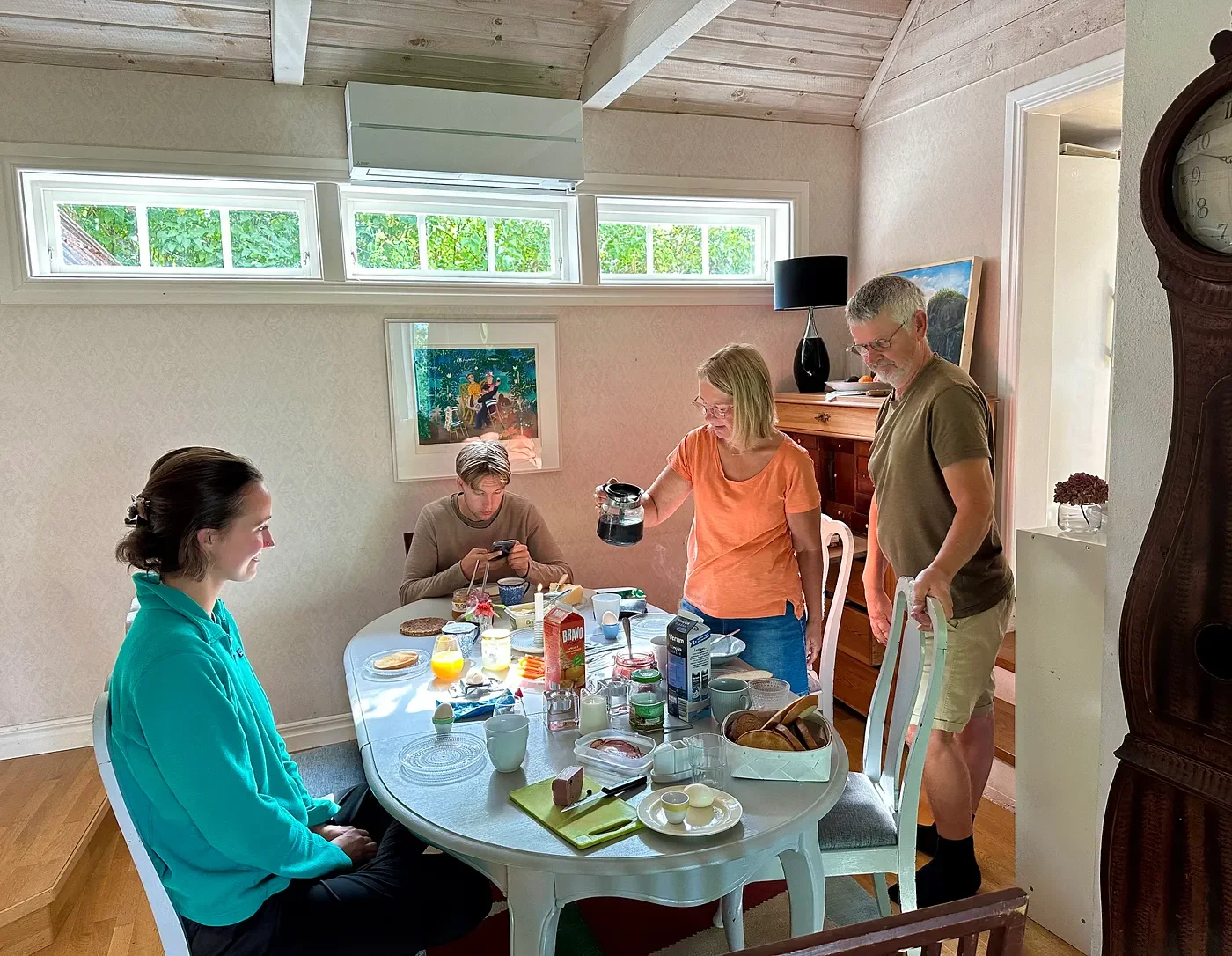
Breakfast taken to another level: egg holders, wooden trays, safts, fancy butter, and homemade strawberry jams.
2. Kalmar (Kalmar County)
I was swept away in utter awe as we glided atop shimmering waters on the 6-kilometre journey across Öland bridge, connecting island and land. Under the commanding gaze of the Kalmar castle, we gallivanted on top of the old Hanseatic city wall, weaved through a towering sand sculpture competition, peeked inside tempting boutiques, and traversed the colorful old cottages before arriving at an explosive garden tea oasis preparing for Shakespeare in the Park. Even the 19th-century Kalmar prison (still functioning and situated directly in the city centre) was kind of beautiful.
We spit out the green stems of jordgubbar purchased on the street corner while Erik pointed out his gymnasium school and Hanna’s university across the river. We made our way to the lush peninsula and cleansed our souls in the deceivingly frigid waters of the Kalmar Strait. How does that Swedish mantra go? Oh yeah —
You never regret a dip!
Man ångrar aldrig ett dopp!
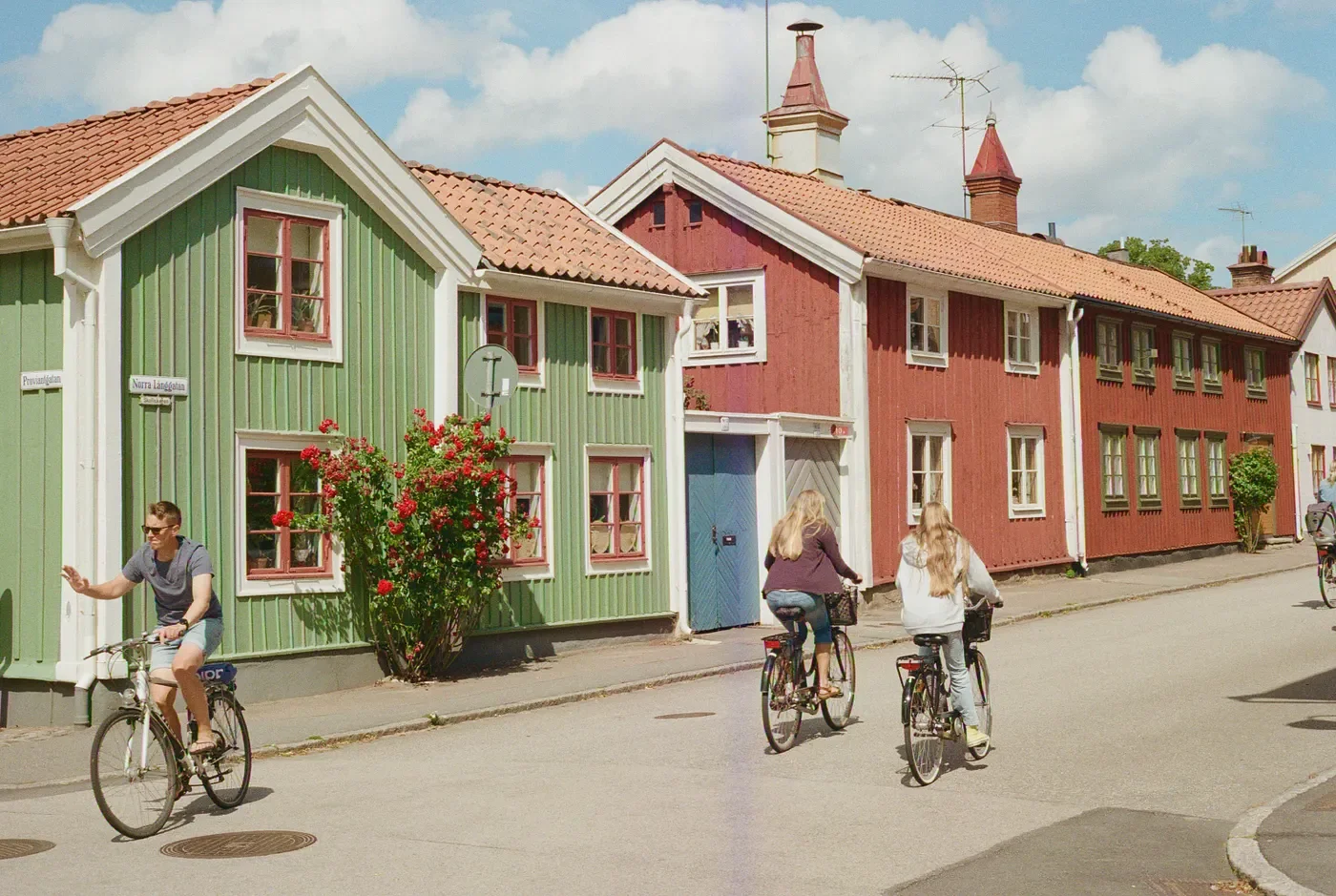
Someone please tell Kalmar Tourist Centre that I’ve got postcard material for them!
3. Fåglasjö (Kalmar County)
The deep forests of Fåglasjö welcomed us with fluorescent chanterelles, wild blueberries, and stories of crayfish (kräftskiva) parties caught by the kilogram in the backyard pond.
If Sweden had a “Country Living” magazine, the Mårtensson’s picturesque yellow countryside cottage would be on the front cover: dancing delicately between modern and traditional with its expansive wooden floors and diamond-shaped windows of stained glass (pictured earlier!)
In typical countryside father fashion, Moa’s dad owned the nearby hobbit-looking forests surrounding a lake that bordered two counties. With the help of ICA, we packed our dinners and headed for this magical place.
Upon arrival, the “brave” ones swam to the island (or rather the big floating rock) while the practical ones transported our packed dinners via row boat (thank you Leo & Moa). As the midnight sun engulfed the water in its white light, we nourished our bellies, passed around fishing rods, and took turns riding the row boat back to the mainland.
Like little red gifts from the green mossy earth, we collected the season’s first lingonberries — a sign that read “autumn is approaching in Scandinavia.” In lieu of a bag, I created a pouch in my green sweatshirt — stained forever red.
We returned home and, until the wee hours of the morning, played board games that required Nettan to be my personal translator. The inner children of ten “adults” were alive and well on the enclosed back porch, furry little Anni being the most mature of us all.
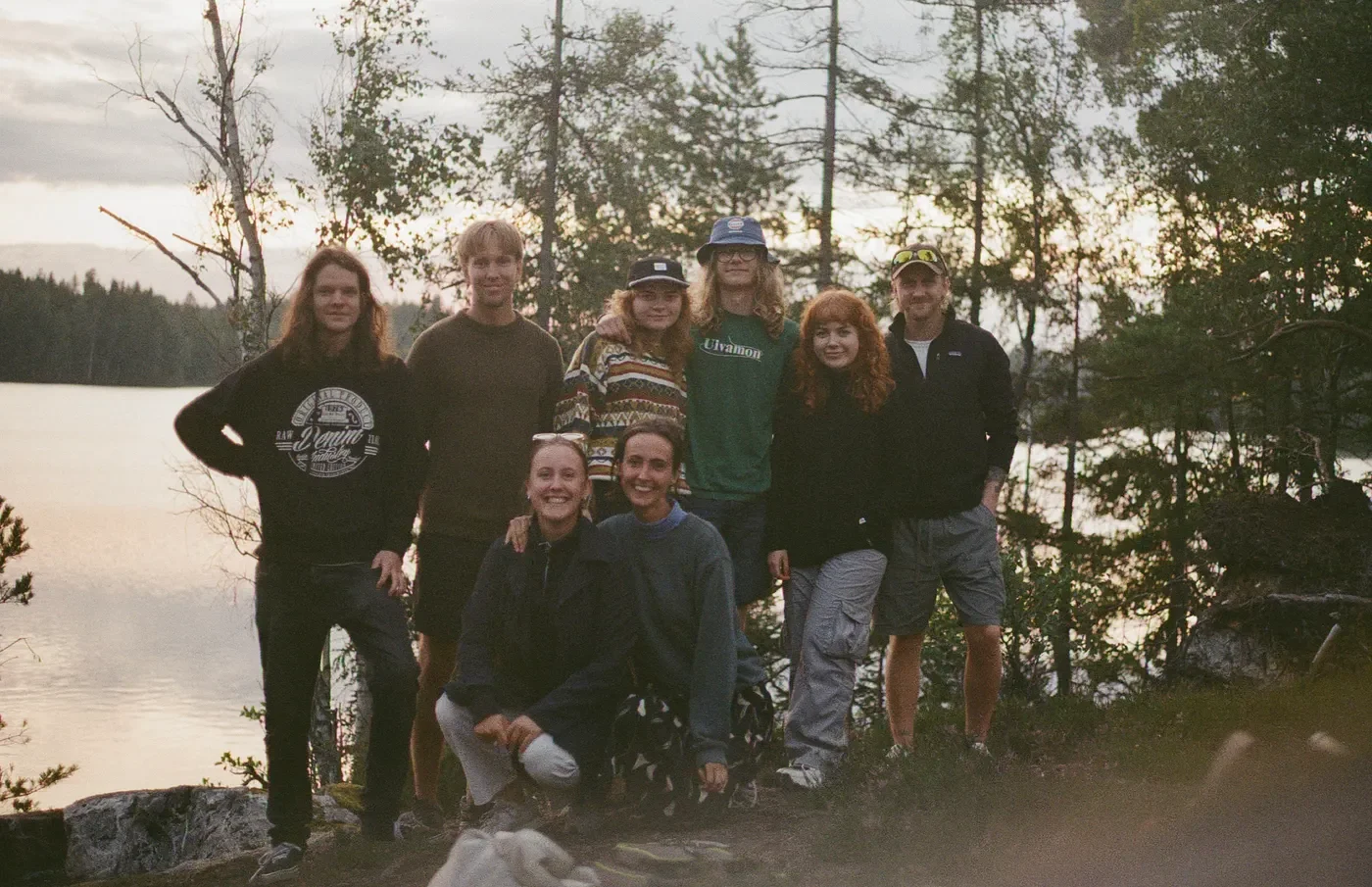
Top row reserved for REAL Swedes: Karl, Erik, Moa, Leo, Johanna, & Ludde. Bottom row reserved for those who try.
4. Karlskrona (Blekinge County)
“The picturesque marine port of Karlskrona almost took Stockholm’s spot as capital back in the day.” This is a fact that locals are keen on sharing and cannot quite seem to forget. Valid.
At golden hour, Imke and I weaved our way through the paths of Sweden’s most popular postcard motif: an allotment of preserved traditional 1920s falu red cottages on Brändaholm. I was bludgeoned by bliss as we biked with child-like zeal along the rocky coast, plucking apples from trees without braking.
It was on the front steps of Amiralitetskyrkan church where I learned about the Swedish school graduation traditions: singing & sailor hats (studentmössa). We couldn’t leave without feeding the hungry statue of Rosenbom whose sign read: “I humbly beg of you, even though my voice may be weak, come and put a penny in, but first lift my hat. Blessed are those that care for the poor.”
But wait, does he have Swish?
The next morning, I stuck a discarded sticker on my chest and snuck into the waterfront naval museum. Imke, being the rule-abiding citizen that she is, waited on the bench outside. We lost each other in the prison-turned-hostel and by the time Imke found me I had already received an invitation from two Swedish women who happened to enthusiastically run a “Lone Star Texas Konferenscenter” in Scåne county. They were showing me a picture of their slogan on Facebook: “TEXAS — CLOSER THAN YOU THINK.” Well that took an unexpected turn! Sadly, we declined.
After a luxurious night in the waterfront Scandic Hotel (made affordable thanks to our last time claiming student discount), we hopped back in the top front window seats of the double-decker bus and returned to Öland before solemnly parting ways.
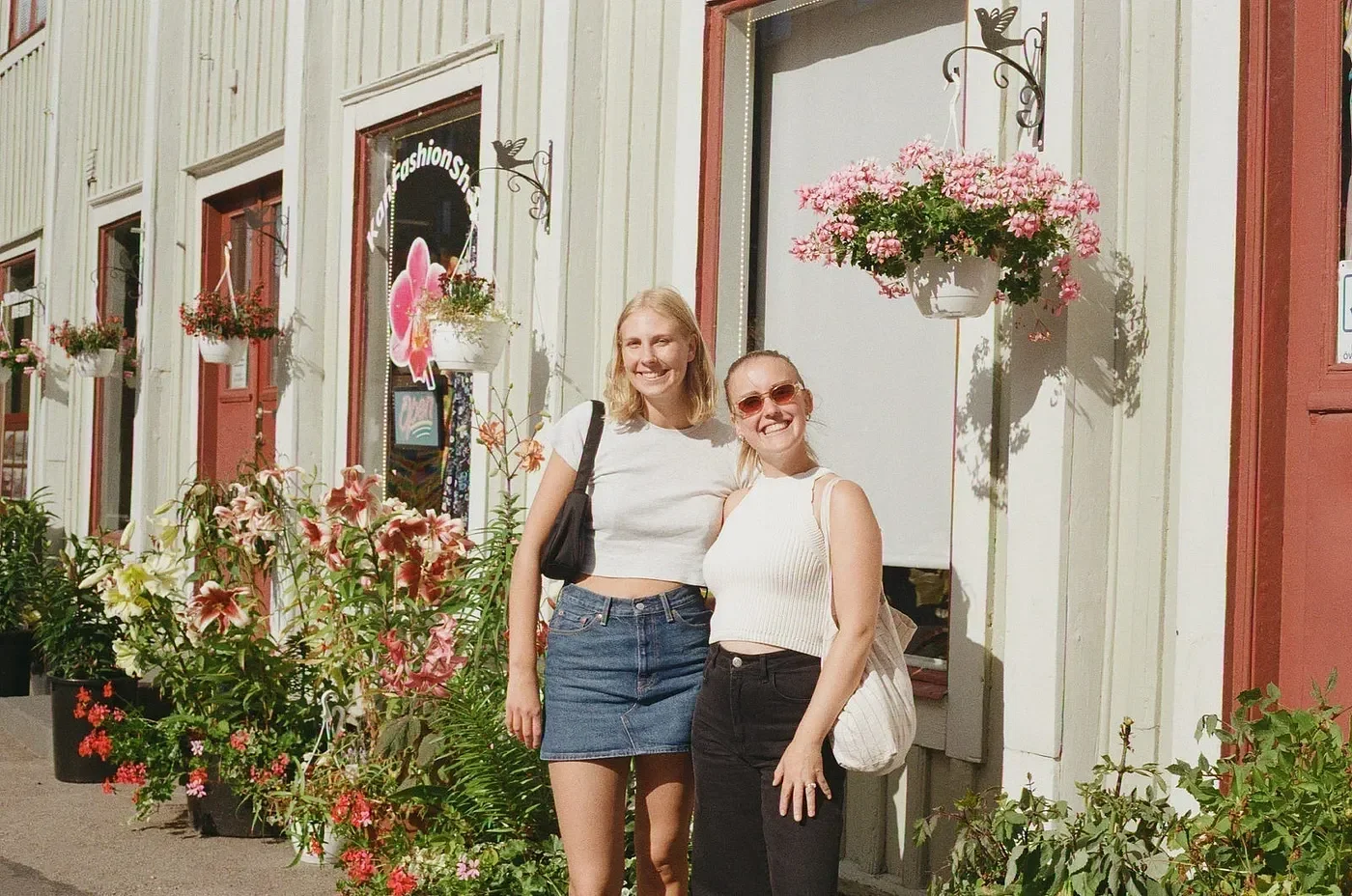
Karlskrona native, Nellie, after giving us a tour of her Baroque city (which included queuing an hour for American-sized ice cream at the famous ‘Glassiären’).
5. Perserud (Värmeland County)
Arriving in the vibrant village of Perserud felt like I was copied and pasted into some faraway fictional fairytale land that you only end up by accident. It was like I got off at the wrong train station on my way to Oslo and slept walked to the least likely place you might find an American.
Along with his two older brothers, Nils marks the sixth generation of Elofsson on this land. Their 19th-century countryside home felt more like a wooden White House after I had become accustomed to ducking my head between rooms. I could’ve sworn I even saw some gnomes corroborating in the corridor and fairies gossiping among the front-yard flowers as we plucked wild raspberries for Nils’ homemade birthday cake.
It’s that kind of place.
Aunts, uncles, and cousins live just a stone’s throw away — joining for afternoon fika by foot. As if living characters themselves, each village home has its own inherited nickname (Lycka, Tallheden, Gärdet). I noticed it was customary to hang a photo depicting the great-great-great-great-great grandparents standing outside of each home: a reminder of the kin who lived equally colorful lives under the same roof; who walked up the same front steps; who continue to whisper life through the walls.
One of the first sentences I was greeted with upon arrival was, “a villager gave birth last night!” I quickly learned that the hand-drawn family tree hanging in the red schoolhouse would soon be updated to accurately reflect the new life in Perserud. I was swallowed in this level of inter-generational history as described by Magnus (Nils’ dad aka Perserud Encyclopedia) on a walking tour around the long and wide gravel path. With every crunch, a story awaited:
“That’s the creek where the villagers once did their laundry,” “That’s the wooden playground I helped to build,” “That’s the Midsommar pole where we did all the funny dances,” “That was once the house of the village blacksmith, and across from it the cottage for soldiers,” “That tree stump was converted into a metal sculpture by Ulf: the local eccentric artist.”
I always imagined that life in the countryside would be boring. But when the family roots extend so deep that they almost touch the Earth’s core, there was a lot for me to catch up on. To say that I was smitten by the comical village politics would be an understatement. There were recurring characters who emerged without question from the forests and neighbors who spontaneously invited us for fika on their postcard-looking-porch just to subtly flaunt a basket’s worth of chanterelles foraged “somewhere North of Racken lake.”
Come on, Lilly, everyone knows you don’t give away your mushroom spot.
On the final morning, we embarked on a 13-kilometre bike ride around this lake, following the same route Nils’ grandmother would cycle every summer sunrise. Surrounding its rocky perimeter just a century ago was an art colony of painters, sculptures, and poets (let’s just say the quirky character is still alive). I pictured the previous generations of Elofssons ancestors admiring the same stoic forests and swimming in the same waters that invited me again and again for a refreshing baptism. It was the closest I’ve ever felt to past generations, and I wasn’t even close to my own homeland.
With all that said, can you really blame me for being jealous of Nils’ 3-year-old cousin, Ellen, who gets to pick up fresh eggs from the backyards chickens each morning while frolicking in her mother’s old gingham dresses and a carpenter as a father who built her bedroom?
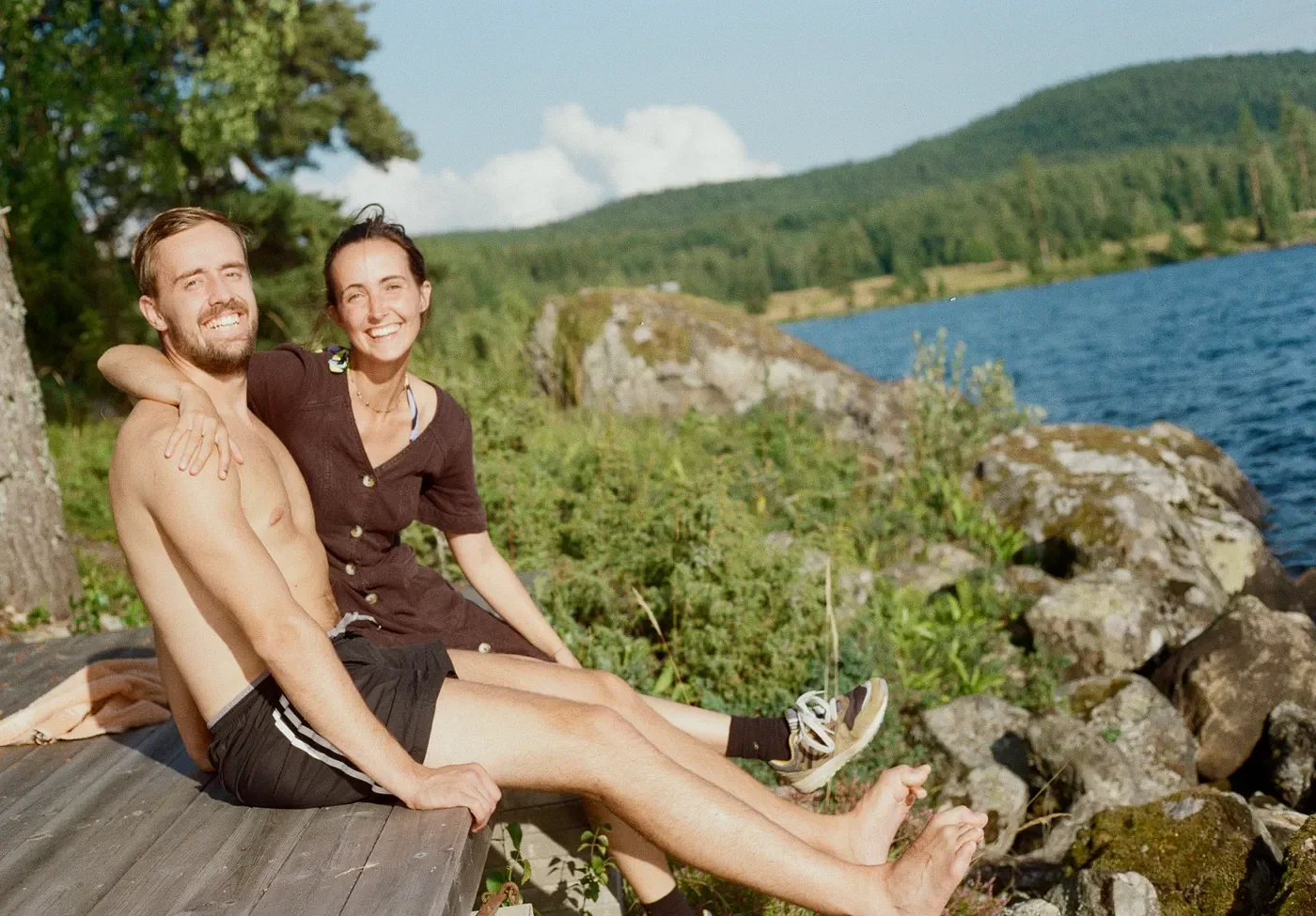
Cue traditional anthem ‘Ack Värmeland, du sköna’ from the top of Storkasberget utsiktstorn!
6. Gothenburg (Göteborg County)
Am I wrong for dubbing Gothenburg the Paris of the Nordics?
There’s just something about the ornate architecture complimented by classy color schemes and iron terraces, while toy-looking trams painted blue buzz through cozy neighborhoods.
Yet the second you exit city limits, you’re bound to meet one of two things: moose or archipelagos. Västkusten bästkusten, am I right? ;)
Being hosted in the childhood home of Lisa’s father was the cherry on top of a journey that already left me feeling “uncomfortably lucky.” I was welcomed into yet another home alive with personal artifacts — like Frederik’s childhood bunk-bed ladder perched in the garden, home to intoxicatingly delicious luktärt that climb up its railings.
I was quickly reminded that Sweden indeed has the world’s most islands after a morning bike ride to an overlook accidentally discovered by Lisa. From this vantage point I learned that the work commute of her mother even involved an occasional kayak trip to reach the adjacent archipelago.
What a life!
Descending from this panorama and into the heart of the archipelagos felt much like entering inside a painting. We walked shoeless across the massive granite boulders while Lisa introduced me to the art (science?) of locating a wind-free nook in the juxtaposing rock. “Are those Swedes or seals sprawled on those rocks?” was a common question that crossed my mind as we traversed the space between sea and stone. Regardless, both of them surely love to soak up every sliver of the fleeting Scandanvian sun while they can.
With wet hair and empty buckets, we headed straight for the wild blueberry hilltops with one goal: to curb the blåbärsstress. What is that, you ask? Well, it’s a word invented by Lisa’s mother to describe the stress experienced upon discovering a forest’s worth of unplucked blueberries — if I don’t pluck them, then who will!?
On the eve of August, we indulged in foraged blueberry pie and stimulating conversation. The number of existential topics were never exhausted at that kitchen table, but Lisa was.
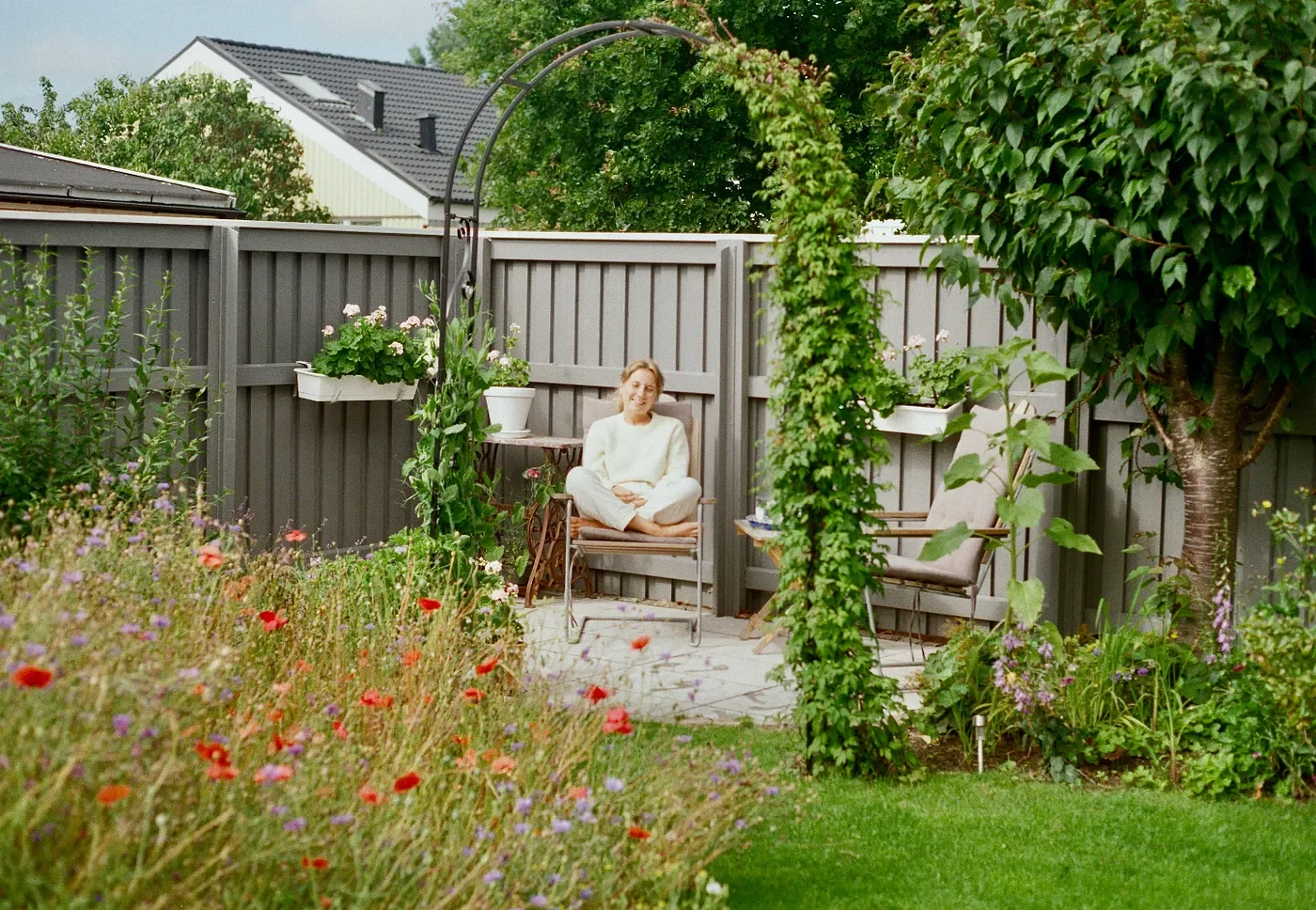
This patio was specifically built to reach the morning sunshine. Is that not the most Swedish thing you’ve ever heard?
From the Nilsson family to the Mårtensson family to the Elofsson family and the Lundgren family — by opening your doors, you’ve opened your hearts. Tack så mycket!
So, would you move to Sweden?
I wouldn’t adopt this pseudo-ethnographer identity or plot my future return unless I felt some sense of home here.
Yet having spent an above-average amount of time around Swedes (and those integrating), I don’t know if I would ever be able to make the move myself. And no, it’s not just because of the brutal winters so far up north…
Side note: I feel compelled to absolve myself of any grievances by saying that each of my exchange friends had the same following conclusion: while the US is ideal for a year abroad, they would never settle there permanently! Something to do with social welfare & security, public transit, gun laws…you know — the basic human rights they grew up with.
With that said, please take my reasons with a little pinch of havssalt ;)
1. Cashless society — would I survive?
Sweden is “the most cashless society in the world today.” Call me old fashioned or sketchy, but I don’t think I will survive in a cashless society. There is something dystopian about how detached we are from money in its physical form.
“Swish” is super common in Sweden: a mobile payment service like Venmo, but more pervasive (even used by street merchants and handcrafters). Of course it can prove to be convenient, but does such ease just encourage mindless consumerism?
Deep breath
I suppose I must brace myself for this soon-to-be cashless reality (if there is still a world that exists by then…but I digress).
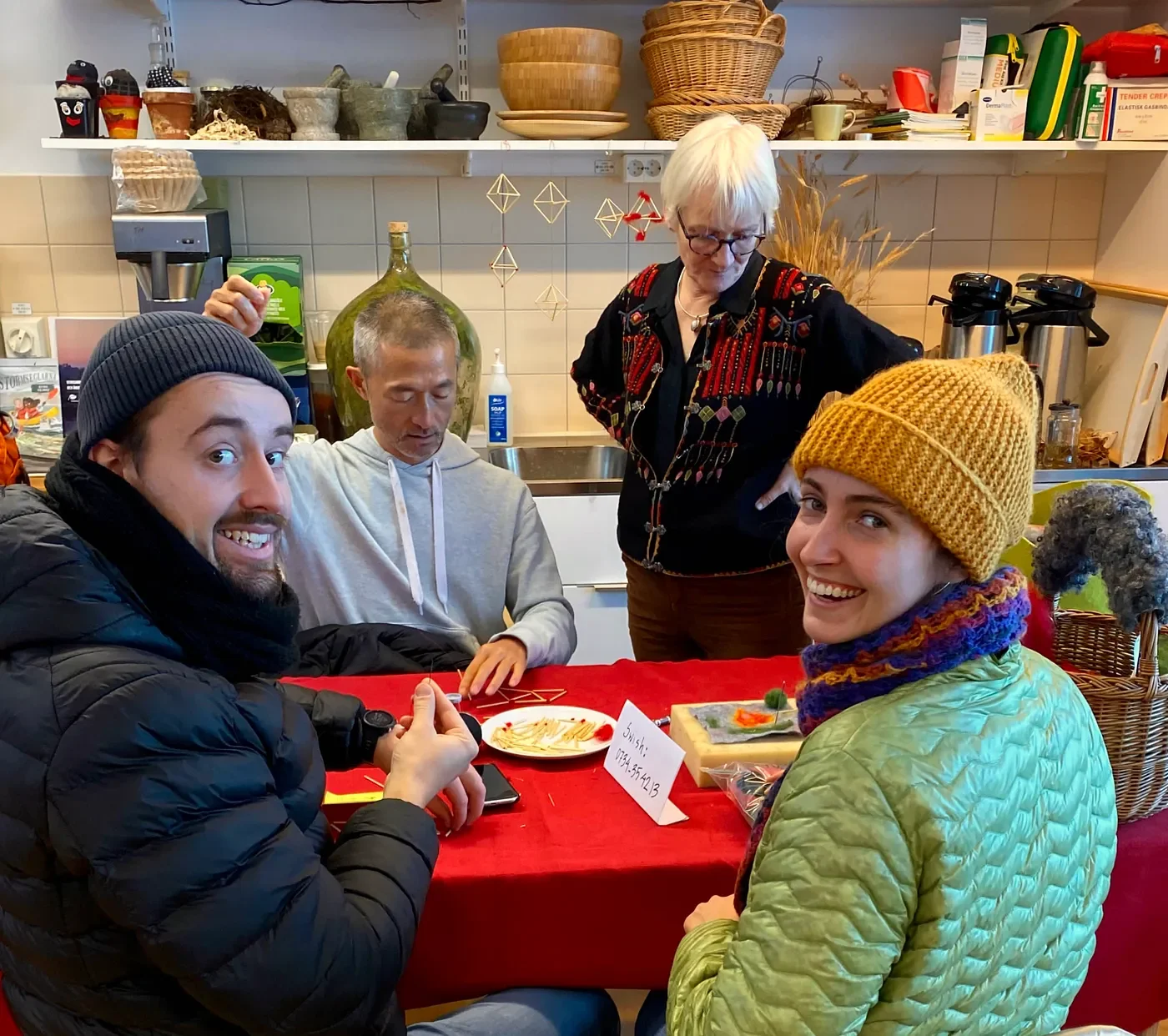
Even the slöjd teacher had her Swish payment number ready on the table!
2. Planning ahead — must I relinquish spontaneity?
Swedes love to plan things very far in advance — especially social life activities!
I promise that your local city Swede already knows exactly what they will be doing next Thursday at 18.00. Perhaps pub quiz night, or pickle-ball, or a first date from Hinge.
If you don’t plan things in advance, good luck making (or keeping) friends. It becomes a chain reaction: because everyone plans so far in advance, you must also plan far in advance otherwise the person you want to make plans with will already have something on their holy calendar.
“Where’s the spontaneity?” I ask.
“I schedule it in every other Wednesday at 17.00,” they reply.
3. Local friends — would I make any?
I quickly understood that integrating into Swedish society and being accepted by Swedish society are two different things.
Swedes tend to stay within their comfort zone when it comes to friend groups. To put it bluntly, the social narrative can be quite exclusive. The fact that Swedes ride or die with their childhood friends can create a hesitation to invite new people into existing groups (especially non-Swedes), or to branch out for new friends.
Don’t get me wrong: I’m all about building life-long friendships! This “exclusive” mentality is not necessarily intentional or personal. Why disrupt the well-established group dynamics? Or force life-long friends to suddenly speak English upon the introduction of a foreigner?
Many ex-pats therefore end up befriending other ex-pats. But this is even when ex-pats do their very best to integrate into Swedish society (like learning the language fluently or extending invitations that end up one-sided).
This phenomenon became clear as we sat in the Stockholm apartment of Imke’s friend Frederiko. Each person who walked through the door had a different mother tongue: from Portuguese to Croatian to French to Russian to Dutch to German to English to Spanish. Imke was considered the closest to a Swede in the room.
At the same time, I want to be careful not to perpetuate the stereotype that Swedes are “cold” or “unfriendly.” I was actually quite surprised by how many strangers returned my smile on the city streets and how many mormor striked up casual conversation (in nearly perfect English)! Perhaps Swedes are just so considerate of other people’s space that they are mistaken as unsociable — a concept that could be explained by hänsyn, or the tendency to consider others.
If you think Swedes aren’t sociable, you probably haven’t been invited for fika...yet!
4. Community — would I find it?
“Does the concept of community, or rather, being part of a community, exist in Sweden like it exists in the US?”…an interesting question we explored at Lisa’s dinner table.
Swedes (and other Northern Europeans) will tell you that looking through the peephole before leaving your apartment is part of the routine. God forbid you run into a neighbor! People would rather take the stairs than share an elevator. Some will wait to take out the trash until the coast is clear.
Okay, perhaps that’s a harsh way of explaining a cultural stereotype that contains some indisputable truth. But what I’m trying to say is that taping introduction flyers to your neighbor’s doors in North Carolina (oops) wouldn’t slide in Sweden.
Side note: there is of course a big difference between community in the city versus community in the countryside.
Finding community is integral to integration. As a white person, it would be objectively easier to integrate into Swedish society. My experience would be completely different than that of the large Syrian refugee population residing in Sweden, or even the experience of an international student of color.
Institutional and covert racism are pervasive in Nordic countries. There are many horrendous accounts of this documented on social media (the most common one being Black men pulled over multiple times with no legitimate reason by Swedish police while on vacation). It would be impossible not to recognize my white privilege when talking about community, as my whiteness posits me a more “acceptable immigrant” in a system built upon racism.
5. Fashion norms — would I fit in?
Swedes turned to stone when they saw me wearing bright colors and embracing funky fashion. I stuck out among the sea of trendy linens in all shades of beige, black, cream, and gray.
If there was an Ocean’s 8 in Sweden, you could imagine: slicked blonde ponytails, thick sunglasses, long black leather coats, creamy mid-length bodycon dress, black platform boots, glossed lips, and tiny handbags.
There seems to be an unwritten ‘Book of Trends’ that one should consult before preparing for a night out.
To further prove my point :
On Nils’ 25th birthday, two other friends showed up in the same exact outfit. To this day, I refuse to believe that this was unplanned. We dubbed it the “Swedish uniform” and you bet that my rendition of the pale yellow collared shirt and cream pants was quite literally the first thing I packed for my visit to Perserud.
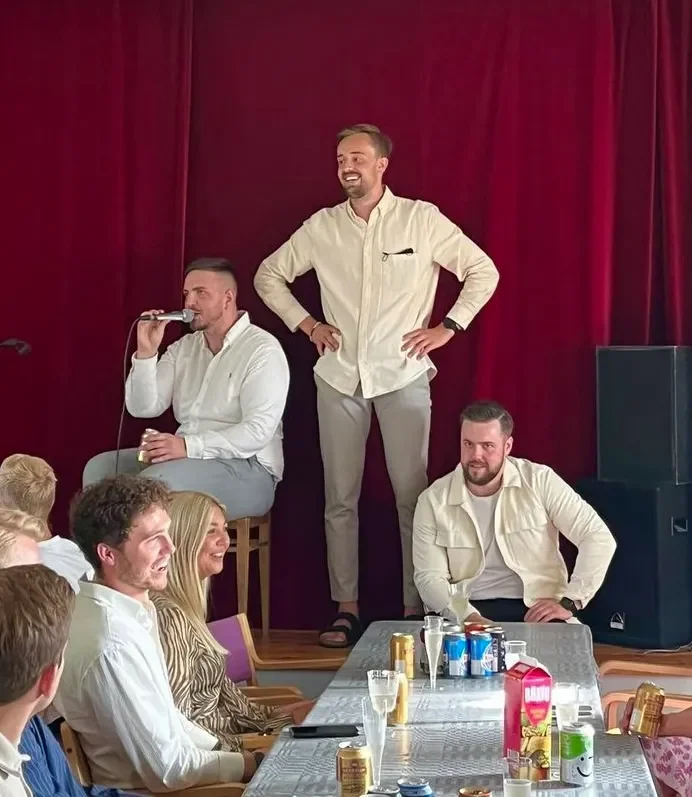
“I swear it was unplanned.” — Nils Elofsson
Lisa shared that after a year of exchange in the US she feared returning to some of the fashion standards/expectations that exist in Sweden. Let’s just say that the normalized college culture of wearing t-shirts, sweatpants, and Birkenstocks to class is not something that would slide in Swedish universities. While I had once been quick to roll my eyes at the “pajamas-to-class” culture in the US, she made an interesting point: more emphasis is placed on your intellectual ability than on your appearance as a result. Hmm, interesting.
On that note, there are certainly some Swedes who fixate on status symbols like name brand clothing (you might find them shopping on Biblioteksstan). This brings me to an important Swedish mindset called janta, or remaining humble at all costs. “Don’t brag, blend in.” It sounds like just a nice motto on the surface, but can manifest in a self-inflicting modesty that leads to low self-confidence (and perhaps explains why one chooses to wear neutral colors). My unprofessional theory: showcasing these name brand status symbols are a way around janta culture — instead of speaking it, you’re showing it.
Even when she tried extra, Immie still felt underdressed compared to the other girls goggling at Viktor Leksell during his concert inside the 900-year-old Borgholm castle ruins. If that’s the case, then I definitely stood out in the thrifted Norwegian sweater (shoutout to Moa who is enabling the second-hand revolution to grow deeper roots in Kalmar ;)
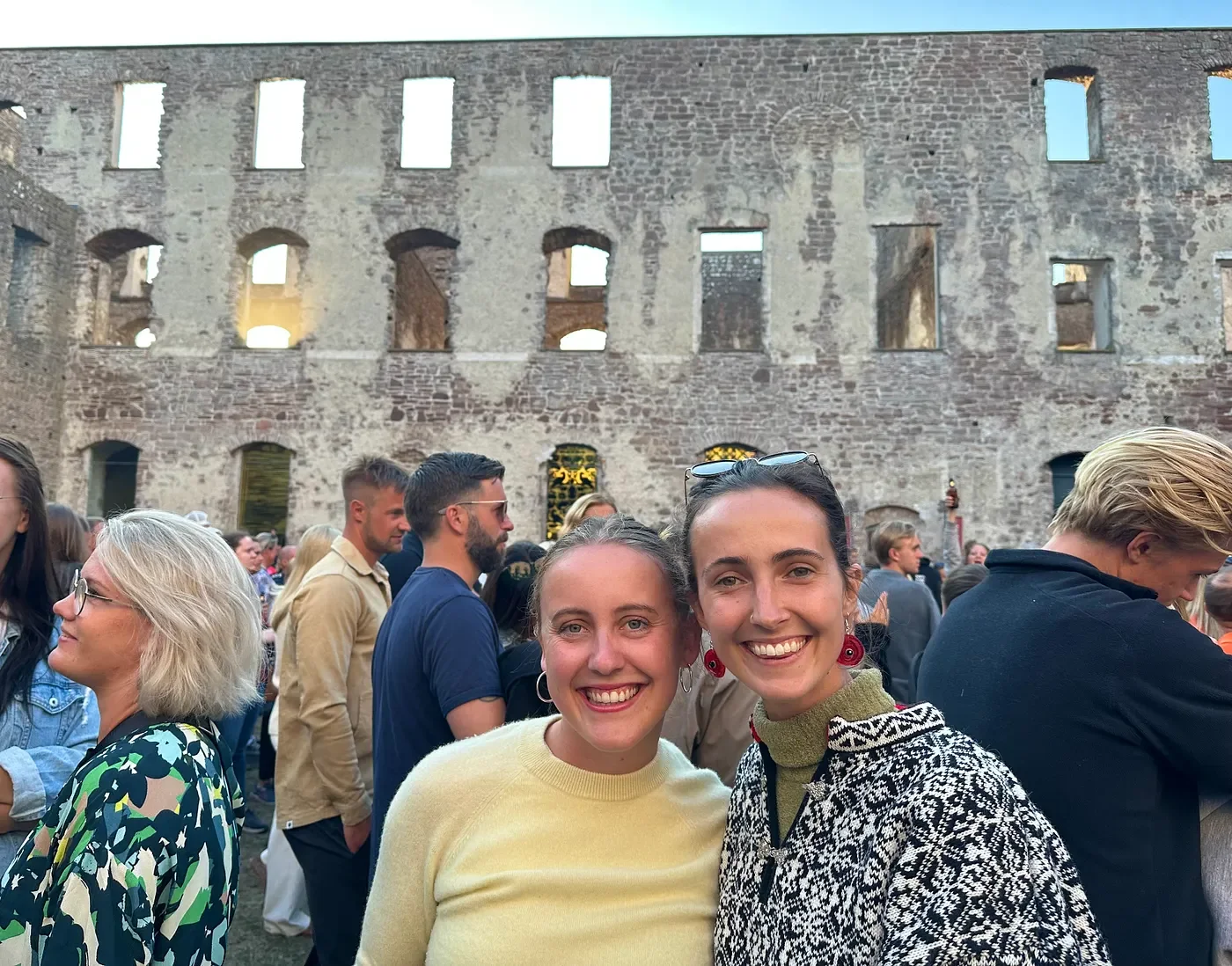
13th century ancestors rolling in their graves as they witnessed fan-girling within their defensive fortification walls. Öland, Sweden.
6. Education system — is it too chill?
I, like most American university students, became accustomed to taking 18+ credit hours each semester, organizing two clubs at once, practicing tennis until midnight, working multiple jobs, volunteering, studying until the library closes, and constantly spreading myself so thin that I bordered breakdown.
Meanwhile, at Swedish universities, students take just ONE class at a time which meets 1–2 times per week. University is free AND students receive a monthly governmental stipend on top of that! Taking a gap year (or two) before entering university around the age of twenty is also far more normalized in Sweden (and across Europe).
While studying in Sweden means a more balanced life in a system that values quality over quantity, it can also come at the cost of less motivation among students in the classroom. There are some people who choose to pursue university just because they can, not because they are genuinely passionate about a subject. American students, on the other hand, are often more eager and motivated to participate in the classroom after paying an arm and a leg to be there. Perhaps this difference is the (worthwhile) downside of social welfare.
Ultimately, these social welfare benefits would far outweigh my list of completely serious grievances if I were to seriously consider a move to Sweden — but that implies finding a sambo and enduring the incredibly lengthy citizenship process first.
And it’s hard to tell whether this 5,000 word post would be used for or against my case.
But what I do know is:
Jag älskar dig, Sverige! I love you, Sweden!
But wait…is it even culturally appropriate for me to say that? One of the most fascinating discoveries I had was at a dinner table in Gothenburg split half Swedes/Americans. The unexpectedly deep conversation was about three words which contain such earth-shattering depth that, when strung together, make the average Swede uncomfortable.
Jag älskar dig.
I love you.
In fact, “I love you” is a weak English translation of the power contained behind its Swedish “equivalent.”
To put in perspective how serious those words are: it’s not even customary to say this to your parents or grandparents in the same way we Americans often do. It was both shocking and endearing to witness the Swedes at the table nervously pep-talk each other into finally telling their parents “jag älskar dig.”
It’s that goddamn nerve-racking!
“Those words are reserved for like three people in your entire life,” was the way it was explained to us Americans at the dinner table.
Our conclusion: perhaps the Swedish language needs something in-between I like and I love you, while the English language needs to reclaim the power of I love you, or come up with something juicier altogether.
Since that first snowy December, I’ve returned to Swedish soil again and again — proving this blog post impossible to complete. Just as I’m ready to wrap this thing up with a pretty little bow, I visit again and boom: I’m supersaturated with new musings all over. Perhaps there will need to be an updated version in a few years.
But until then:
Befriend your local international students and you might just receive the most authentic, once-in-a-lifetime experience of their homeland.
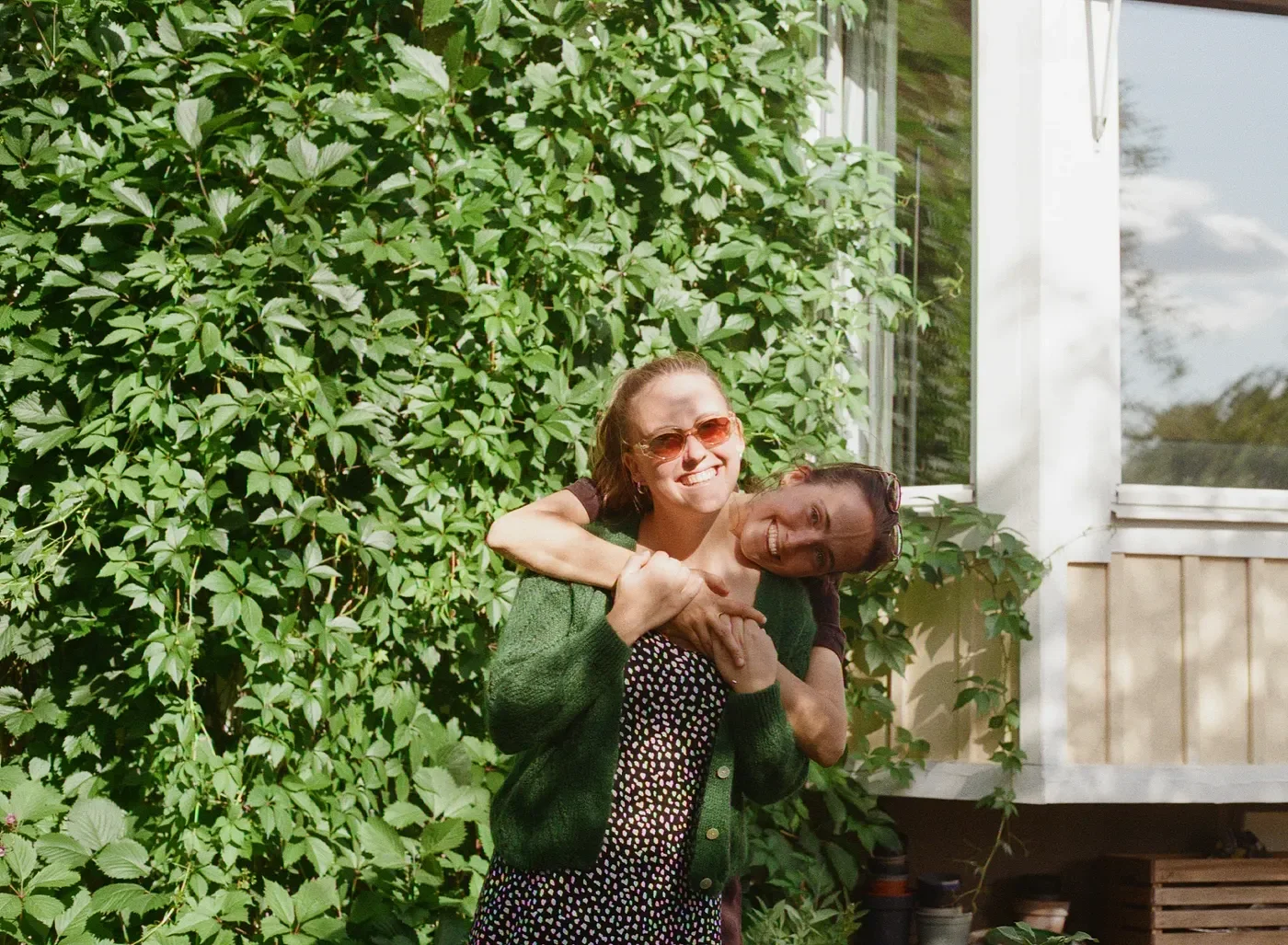
The one who made it all possible!
December 2022. July 2023. August 2023. December 2023…To Be Continued.
